
There is a question Canadian business owners ask more often than people might think.
It usually comes up after a website has been live for a year or two, maybe longer. The site looks fine, nothing obviously broken, but the phone is not ringing the way it should. People visit. They leave. Bookings are flat. Sales are underwhelming. And somewhere in the back of their mind, the business owner starts to wonder, Is it the website?
More often than not, the answer is yes. But not in the way you might expect.
The problem is rarely that the website looks bad. The problem is that it was built to look good and nothing else. No real thought went into what happens after someone lands on it. No strategy behind the layout. No understanding of what makes a visitor stay versus bounce. Just a design, handed over, and a bill paid.
That is the gap between your typical web design agency and a web design agency in Canada that actually understands growth. And knowing how to tell them apart before you choose one could be the most important thing you do for your business this year.
We have been building websites and running growth strategies for Canadian brands since 2017, across industries including jewelry, dental, automotive, home renovation, and aesthetics. We have seen what separates sites that convert from sites that just exist. This guide will walk you through everything you need to know when evaluating a web design agency in Canada, so you can make a decision you will not have to undo in six months.
A Website Is Not a Brochure Anymore
Let us start here, because this mindset shift is everything.
For a long time, the job of a website was to exist. You needed one because people expected to find you online. It held your address, your phone number, maybe a few photos of your work, and a contact form that may or may not have sent emails reliably. That was enough.
That era is over.
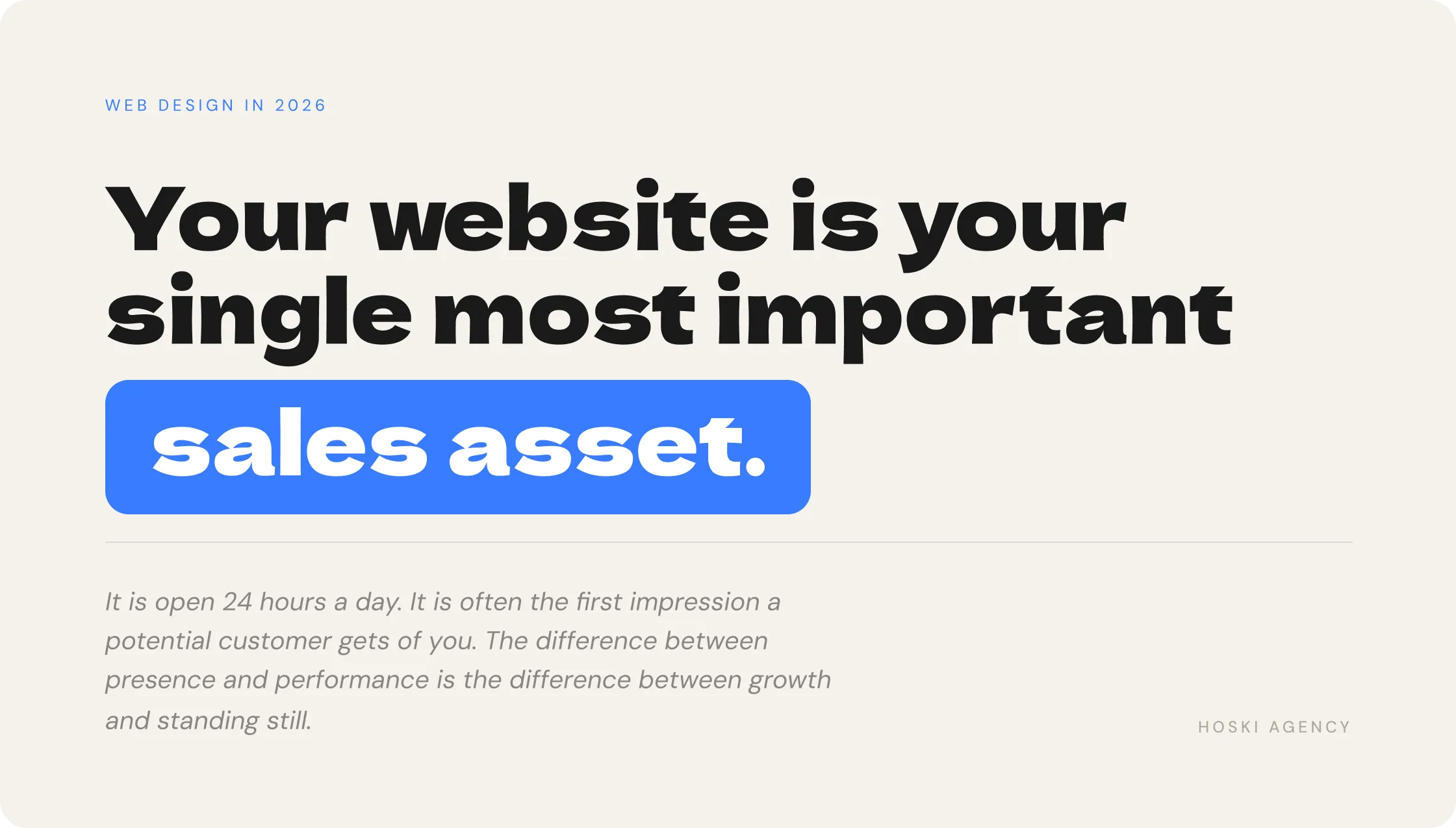
Today, your website is the single most important sales asset your business has. It is open 24 hours a day. It is often the first impression a potential customer gets of you. And in a market where people spend less than 10 seconds deciding whether to stay or leave a page, the difference between a site built for presence and a site built for performance is the difference between a business that grows and one that stays stuck.
A true web design agency in Canada understands this. They are not just thinking about how your site looks. They are thinking about where your visitors go, what they do, why they leave, and how to get more of them to take action. That is a fundamentally different way of approaching the work.
What Most Web Design Agencies in Canada Actually Deliver
This is worth being honest about.
The majority of web design agencies, not just in Canada but everywhere, are structured around delivery. You brief them on what you want, they design it, they build it, and they hand it over. Maybe there is a round of revisions. Maybe there is not. Either way, once the site is live, the engagement ends.
You get a site. They get paid. Everyone moves on.
The problem is that delivery and performance are not the same thing. A site can be delivered on time, within budget, and look exactly the way you imagined it, while still being completely ineffective at generating leads, bookings, or sales.
Here is why that happens. Most web design agencies are not thinking about your business model. They are thinking about the project. They are not asking what your margins look like, what your average customer is worth, or where your current customers actually come from. They are thinking about navigation menus, font choices, and image layouts. All of which matter, but none of which will rescue a website that was built without a conversion strategy underneath it.
The agencies that produce real growth results think differently. They ask different questions before they open a design tool. And that shift in mindset is what you should be looking for when you evaluate a web design agency in Canada.
The Questions a Growth-Focused Agency Asks Before Designing Anything
Before any design work begins, the right web design agency should want to understand your business. Not just what it does, but how it works.
That means asking things like:
Where does your traffic currently come from? If most of your visitors come from Instagram and your website has no visual connection to your social presence, there is a disconnect that will cost you conversions before a single design decision is made.
What does a customer typically do before they contact you? Some customers research for weeks. Others decide in minutes. The structure of your site needs to match the way your specific customer thinks and moves.
What is the single action you want a visitor to take? Not three actions. Not a list of options. One. The agencies that drive results know that clarity converts and confusion does not.
What is a new customer worth to your business? This matters because it shapes the entire conversation about what kind of website investment makes sense. A business where a single customer is worth $50,000 over their lifetime should approach web design very differently from a business where the average transaction is $80.
What does your current site do well, and where does it fall apart? A good agency will not assume the answer to this. They will look at your analytics, study your bounce rates, understand where visitors are dropping off, and use that information to make informed decisions.
If you sit down with a web design agency and they skip these questions in favour of talking about templates, colour palettes, and turnaround times, that is information worth paying attention to.
Design and Conversion: Why They Have to Work Together
Here is something that gets missed in a lot of web design conversations.
Beautiful design and high-converting design are not the same thing. They can coexist, and they should, but one does not automatically produce the other.
A website can be visually stunning and still be completely confusing to navigate. It can have gorgeous photography and still have a contact form buried three clicks deep. It can win design awards and still generate almost no leads.
Conversion rate optimization, often called CRO, is the practice of designing and refining a website with the explicit goal of getting more visitors to take the action you want them to take. It is part science and part psychology. It is about understanding what makes people click, what makes them trust a business, and what makes them hesitate.
The best web design agencies in Canada bring CRO thinking into every decision they make. Where does the eye naturally land on a page? Is the most important message appearing before the visitor has to scroll? Does the call to action feel natural in context, or does it feel like an interruption? Are there unnecessary steps between someone's interest and their ability to contact you?
At Höski, we worked with ClubExec Auto, a Canadian automotive brand, and one of the primary focuses of their site build was reducing the number of clicks between a visitor arriving and a visitor taking action. The result was a 6.4 percent conversion rate on the site. That is not an accident. That is what happens when design and conversion strategy are working together instead of being treated as separate concerns.
Conversion rate for ClubExec Auto
Built by reducing the number of clicks between a visitor arriving and a visitor taking action. Design and conversion strategy working together.
The Web Design Process: What It Should Actually Look Like
A lot of business owners are not sure what to expect from the process of building a website. They know there will be a design phase. They know there will be a build phase. Beyond that, it gets vague.
Here is what a professional, growth-focused web design process should look like.
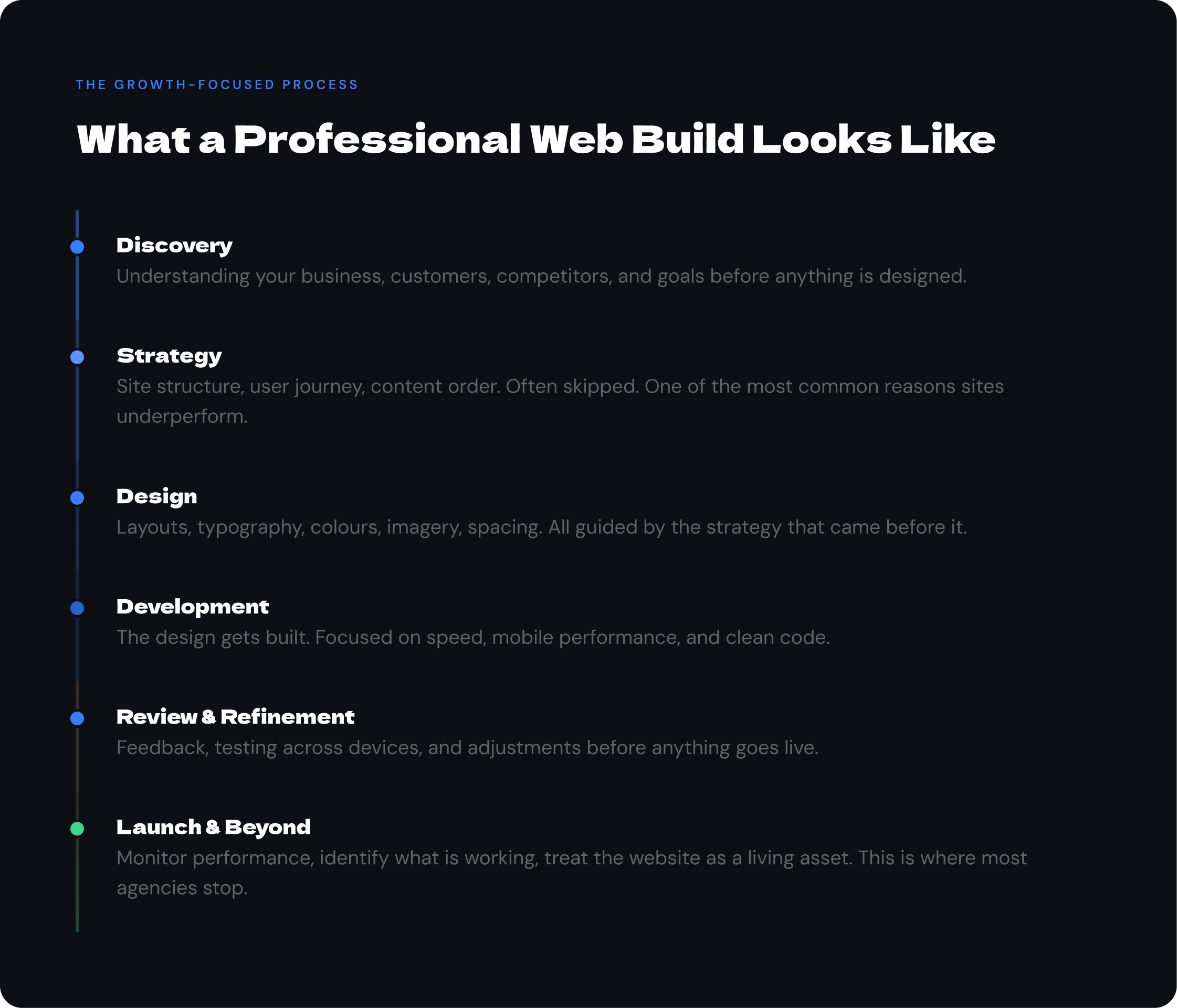
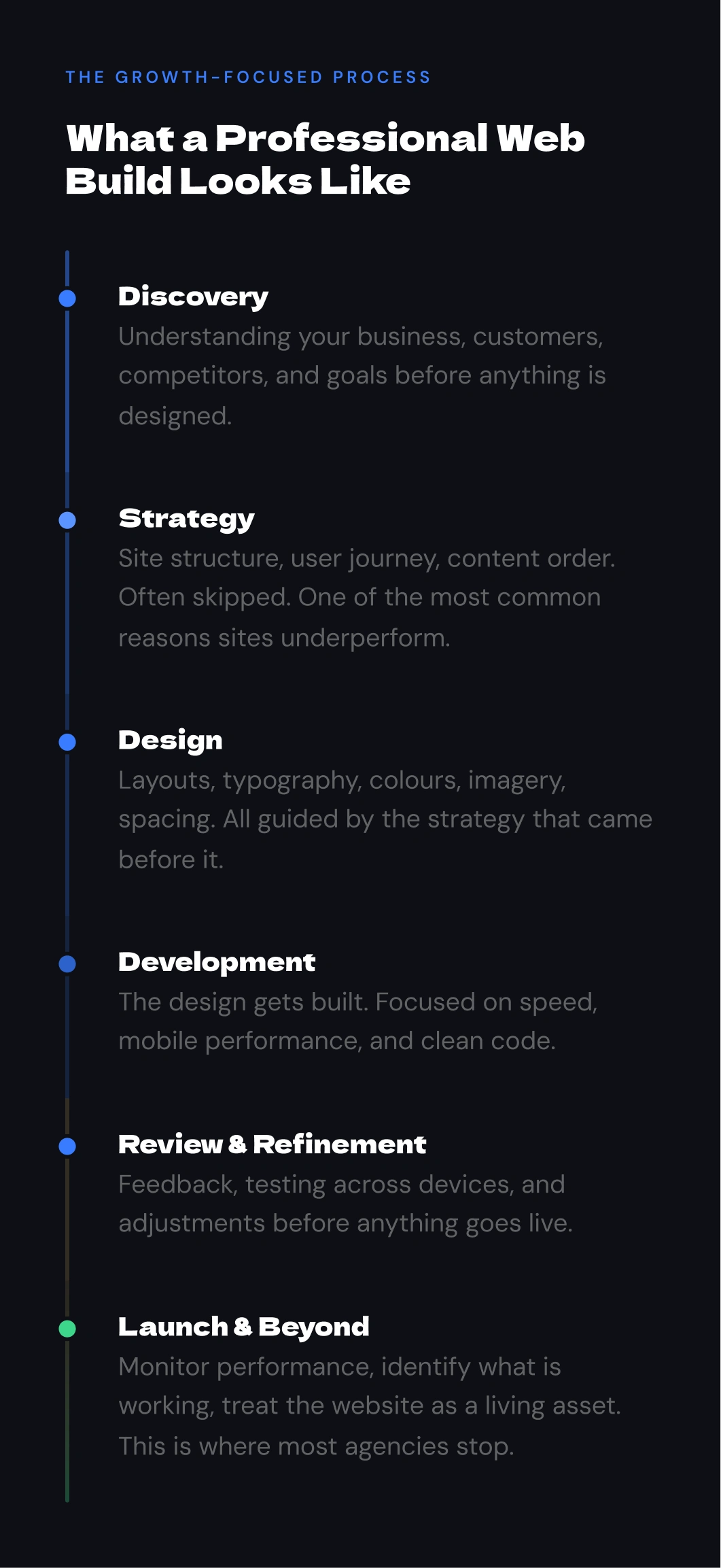
Discovery. Before anything is designed, the agency should spend time understanding your business, your customers, your competitors, and your goals. This is where the questions from the previous section come in. A discovery process that is skipped or rushed produces a website that could have been built for anyone.
Strategy. This is where the structure of the site is determined. How many pages? What goes on each page? What the user journey looks like from landing on the site to taking action. What content needs to exist and in what order? This step is often skipped by agencies focused purely on design, and it is one of the most common reasons websites underperform.
Design. This is the visual work. Layouts, typography, colours, imagery, spacing. All of it should be guided by the strategy that came before it, not invented independently of it.
Development. The design gets built. This phase should be focused on speed, mobile performance, and clean code. A beautiful design that loads slowly is a problem: Google measures load time as a ranking factor, and users leave slow sites quickly.
Review and refinement. A professional agency builds in time for feedback, testing across devices, and adjustments before anything goes live.
Launch and beyond. Here is where most agencies stop. A growth-focused agency does not. They monitor performance after launch, look at what is working and what is not, and treat the website as a living asset rather than a completed project.
This is the process that produces websites that actually do something. Anything shorter or more informal than this should raise questions.
What a Good Web Design Agency Does With Your Existing Traffic
There is a mistake that a lot of businesses make when they decide to rebuild their website.
They focus entirely on the new site and forget to think about what happens to the visitors they are already getting.
If your site is getting traffic right now, whether from Google, from social media, from referrals, or from anywhere else, that traffic has value. And a poorly managed website migration can destroy years of search engine progress overnight.
A professional agency will think carefully about what happens to your existing URLs. They will put redirects in place so that any pages that move or change their address still pass their value to the new site. They will make sure your metadata is set up correctly. They will think about how the new site communicates its content to Google so that your rankings are protected, and ideally improved.
This is called technical SEO, and while it might sound complicated, what it means in practice is simple: when your new site goes live, you want Google to understand what it is about, trust it, and rank it well. A web design agency that does not think about this is one that may hand you a beautiful new site that loses half its traffic in the first month.
Industry Experience Matters More Than You Might Think
This is not something every web design agency will tell you, but it is true.
A web design agency that has experience in your specific industry will almost always produce better results than one that does not. Not because they are more technically skilled, but because they understand the psychology of your customer in a way that takes time to build.
A customer considering a dental procedure is in a very different headspace from a customer considering a home renovation. Someone shopping for fine jewelry is thinking and feeling differently from someone booking an automotive service. The language that builds trust, the proof points that reduce hesitation, and the moments in the user journey that matter most vary by industry.
We have built websites and run growth strategies for dental practices, jewelry brands, automotive businesses, home renovation companies, and aesthetics clinics across Canada. That experience means we are not guessing about what works for these customers. We know what makes them convert because we have seen it at scale.
When evaluating a web design agency, ask to see examples of work in your industry or a closely related one. Ask them what they have learned about the customers in that space. If they cannot speak to that with specificity, that is a sign.
Red Flags to Watch For
We have talked a lot about what good looks like. Here is what to watch out for.
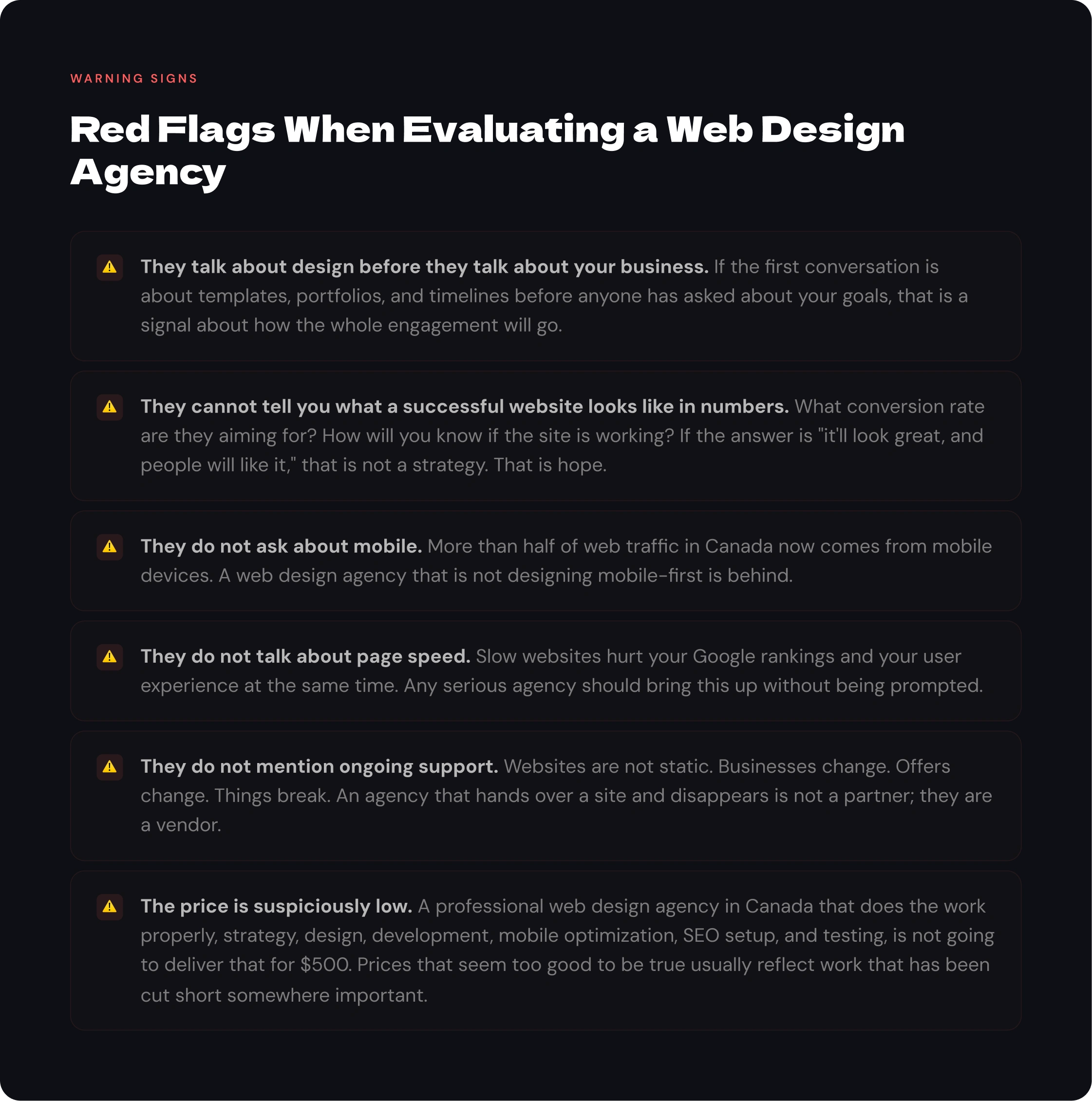
The Difference Between a Web Design Agency and a Growth Agency
There is one more distinction worth drawing, because it matters especially if you are looking for a long-term partner and not just a one-time project.
A traditional web design agency builds you a website. The engagement has a start date and an end date. Once the site is live, the relationship is effectively over unless something breaks.
A growth agency uses your website as a tool inside a larger strategy. They are thinking about how your site connects to your paid media, your email marketing, your social content, and your customer retention. They understand that the website is not the end of the journey; it is the place where the journey either continues or stops.
At Höski, we approach web design through our Web Desk as one component of a full growth system. That means when we build a site, we are already thinking about the ads that will drive traffic to it, the landing pages that will be tested against it, and the email flows that will follow up with visitors who did not convert on the first visit. We helped Remodel My Home close a $424,000 deal in their first 30 days, not because the website was beautiful, though it was, but because it was part of a system that was designed to convert from end to end.
That is a different kind of thinking. And it is the kind of thinking that produces different kinds of results.
Closed in the first 30 days for Remodel My Home
Not because the website was beautiful, though it was, but because it was part of a system designed to convert from end to end.
What to Actually Ask When You Get on a Call With a Web Design Agency
Before you commit, here are the questions worth asking out loud.
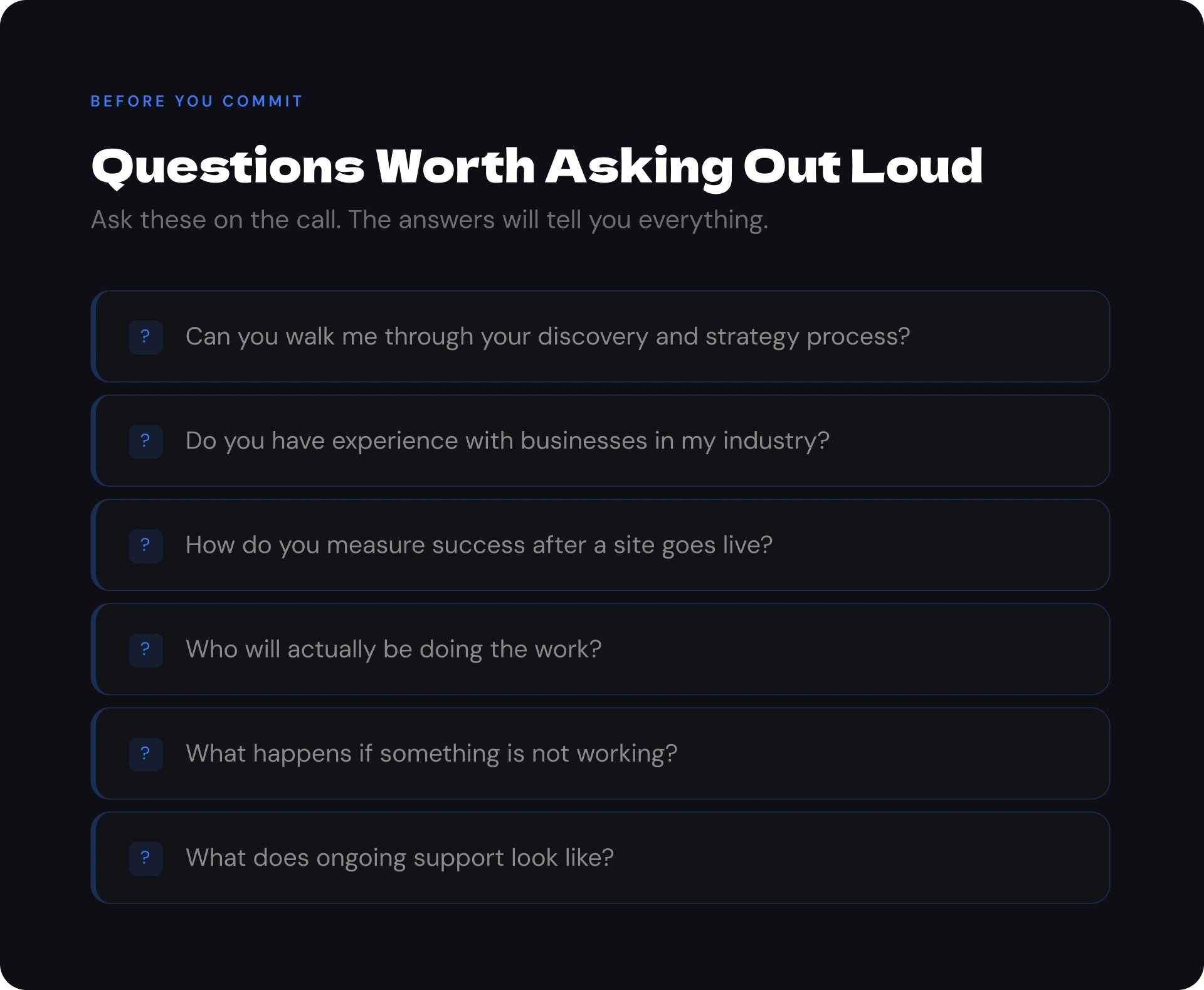
Can you walk me through your discovery and strategy process? You want to hear that there is a process, that it involves understanding your business, and that design decisions come after strategy decisions, not before.
Do you have experience with businesses in my industry? Not a requirement, but valuable. If they do, ask them what they learned and how it shaped their approach.
How do you measure success after a site goes live? The answer should involve metrics: conversion rate, bounce rate, time on site, and leads generated. If the answer is vague or focuses only on aesthetics, that tells you something.
Who will actually be doing the work? Agencies often pitch with senior people and deliver with junior ones. Knowing who will actually be designing and building your site is a reasonable thing to ask.
What happens if something is not working? How does the agency respond when performance is below expectations? Do they have a process for identifying problems and testing solutions, or do they consider their job done once the site is live?
What does ongoing support look like? Is there a maintenance plan? What does it include? What does it cost? These questions protect you from finding yourself with a broken site and no one to call.
Making the Right Choice
Choosing a web design agency in Canada is not just a creative decision. It is a business one.
The right agency will ask hard questions before they start. They will bring strategy to the table alongside design. They will think about your customer's experience on the site with the same level of care they give to how the site looks. And they will treat the launch as the beginning of the work, not the end.
The wrong agency will produce something that looks fine and does almost nothing. They will hand it over, cash the cheque, and move on to the next client. And six months from now, you will be having the same quiet conversation with yourself about whether the website is the problem.
It does not have to go that way.
If you are building or rebuilding a website for your Canadian business and you want a partner who is thinking about growth from the very first conversation, we would be glad to talk. You can book a strategy call with us here, and we will show you exactly how we approach it.