
Protecting your existing traffic is not optional. It is part of the handover process on every Höski Web Desk project.
If you have ever tried to get a straight answer about what a website costs in Canada, you already know how frustrating it is.
You ask an agency. They say, "It depends on your needs," and invite you to a call. You search online and find articles throwing numbers around from $500 to $150,000 with almost no explanation of what moves a project from one end of that range to the other. You ask a friend what they paid, and the number is so far off from what you expected that it raises more questions than it answers.
The lack of honesty around web design pricing in Canada is a real problem for business owners trying to make a smart decision. So this post is going to do what most agencies are reluctant to do: give you real numbers, explain what is behind them, and help you understand what you are actually paying for at each level.
No hedging. No "it depends" without explaining what it depends on. By the end, you will have a clear picture of what web design agency costs in Canada look like in 2026 and, more importantly, how to tell whether a quote represents genuine value or a warning sign.
Why the Price Range Is So Wide
Before getting into the numbers, it helps to understand why someone can quote you $1,500 and another agency can quote you $50,000 for what sounds like the same thing.
A website is not a fixed product. It can be as simple as a five-page site with your contact details, or as complex as a full e-commerce platform built around the specific way your customers buy. The hours involved, the strategic thinking required, and the level of expertise needed are completely different depending on what the site needs to actually do.
There are also big differences in what different types of providers are selling. A freelancer working from home has far lower overhead than an agency with a full team. A template-based shop is doing fundamentally different work from an agency that builds custom, strategy-led sites from scratch. These differences are real, and they show up in the price.
The goal of this breakdown is to help you understand what those differences mean, so you can match the right investment level to what your business actually needs.
The Four Tiers of Web Design Pricing in Canada (2026)
Most web design projects in Canada fall into one of four tiers. Here is what each one includes, what it costs, and who it is actually right for.
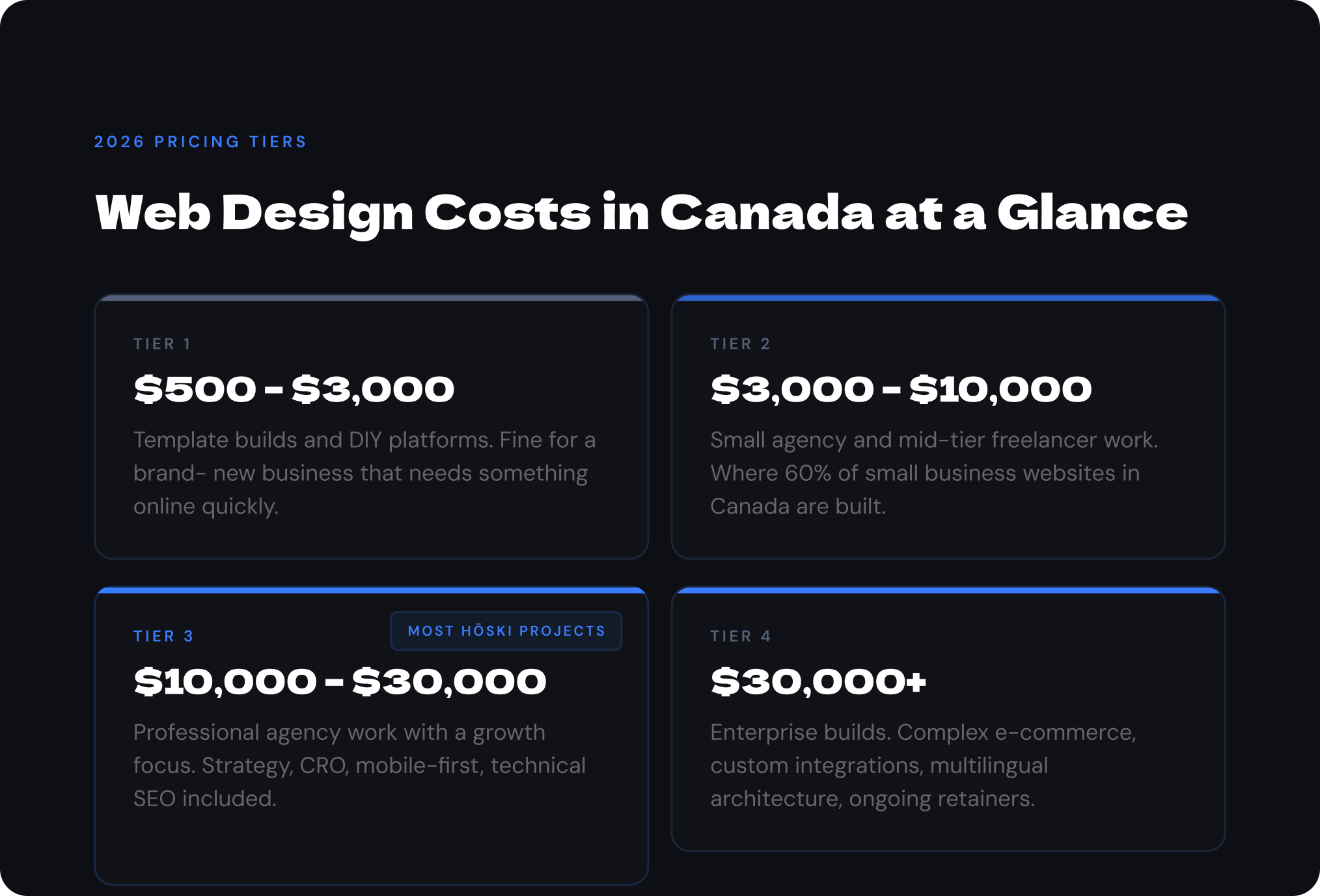
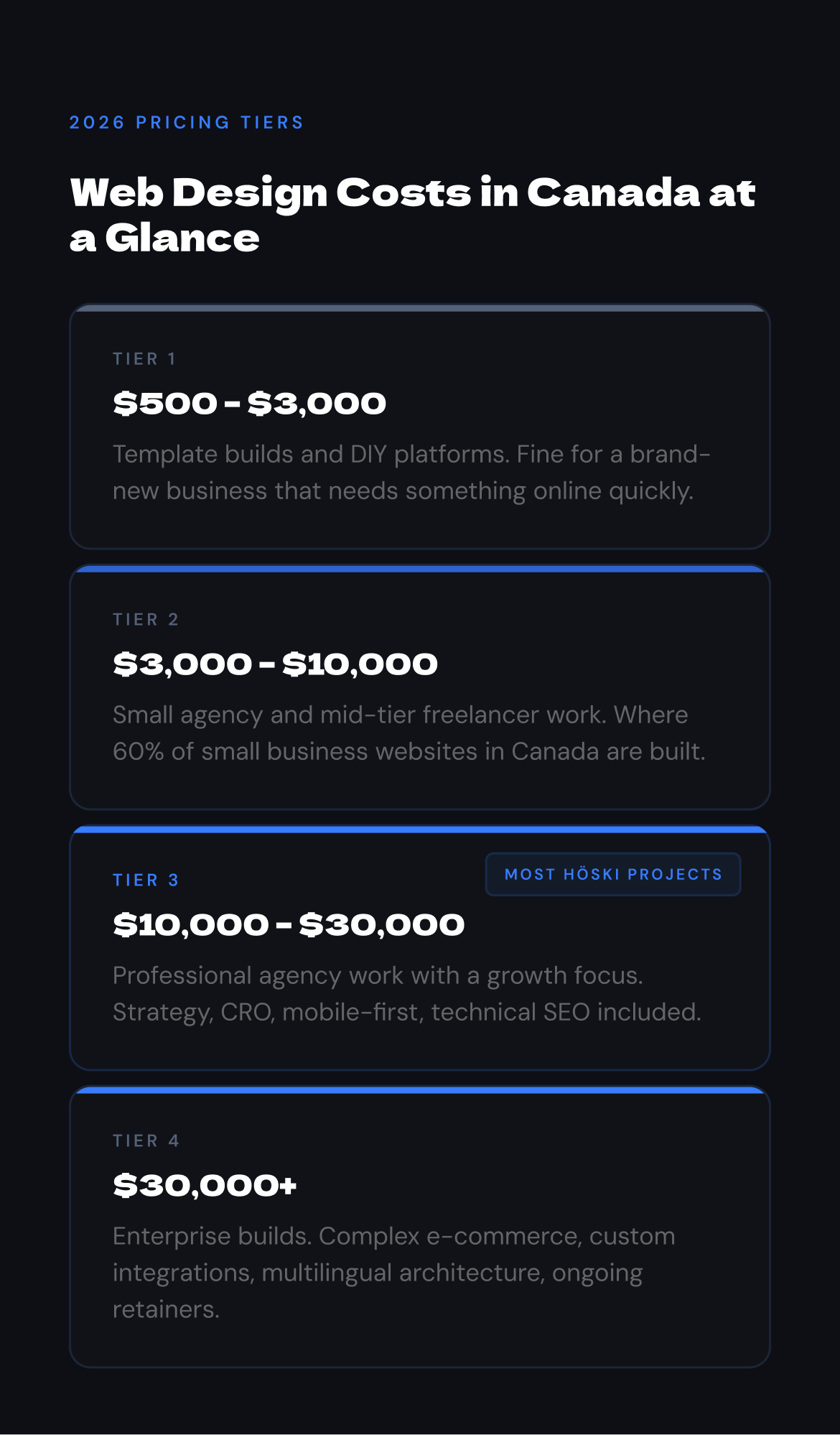
Tier 1: $500 to $3,000 CAD. Template builds and DIY platforms. This covers website builders like Squarespace, Wix, and basic WordPress theme setups. Some newer freelancers also work in this range. You are getting a template with your content, logo, and colours dropped in.
A pre-made layout; your site will look similar to others built on the same template. Basic mobile display, but rarely optimised for mobile conversion. Little to no strategy behind the page structure or user journey. Minimal SEO setup, if any. Typically no support or maintenance after the site is handed over.
This tier is fine for a brand-new business that needs something online quickly and has almost nothing to spend. It is not appropriate for a business that is trying to grow, generate leads, or compete seriously in its market. A $1,500 website will perform like a $1,500 website.
Tier 2: $3,000 to $10,000 CAD. Small agency and mid-tier freelancer work. This is a wide range. At the lower end, you are getting a more customised template with better attention to detail. At the upper end, you start to see some custom design work and basic conversion thinking. This is where 60 percent of small business websites in Canada are built, according to 2026 market data.
More customised design than Tier 1, though often still template-based foundations. Proper mobile compatibility across devices. Basic on-page SEO setup. A defined number of pages, typically five to fifteen. Some thought given to user experience, though not deeply strategic. Light content guidance; copywriting usually falls on you. Limited post-launch support.
This tier suits small businesses that need something professional on a modest budget. The gap at this level is almost always strategy. The site will look acceptable, but there is usually not much thinking behind how it converts visitors into customers. You are paying for design, not growth.
Tier 3: $10,000 to $30,000 CAD. Professional agency work with a growth focus. This is where the conversation shifts from design to performance. Agencies in this range are bringing strategy, conversion thinking, and a proper process to the project. The site is built not just to look good but to actually do something for your business.
A discovery and strategy phase before any design begins. Custom design built around your specific business goals and customer journey. Conversion rate optimisation (CRO) thinking applied throughout the build. Full mobile-first development. Technical SEO setup: URL structure, metadata, redirects, Google Analytics. Copywriting guidance, or full copy in some cases. Performance and speed testing before launch. Post-launch monitoring and support.
This tier is right for established businesses that are serious about growth. The investment reflects the fact that the agency is thinking about your revenue, not just your design. A well-built site in this range, with a proper strategy behind it, can generate significantly more than its cost in additional business within the first year.
Most Höski Web Desk projects sit in this range. Every build starts with a growth discovery session and ends with a site that has been tested and set up to perform from day one. You can see what that looks like on our Web Desk page.
Tier 4: $30,000 and above CAD. Enterprise builds and complex custom development. This tier covers large e-commerce platforms, web applications, enterprise sites with complex integrations, and projects requiring significant custom development beyond standard website building.
Full custom development from the ground up. Complex integrations: CRMs, booking systems, inventory platforms, payment gateways. Large e-commerce with advanced filtering, custom product pages, and checkout optimisation. Multilingual or multi-region site architecture. Extensive content strategy and full copywriting. Ongoing retainer for continuous development and optimisation.
This tier is for businesses with complex operational needs, large product catalogues, or a high enough customer value that the website is a primary revenue asset worth serious ongoing investment.
What Pushes the Cost Up
Within Any Tier
Within each tier, certain factors will push a project toward the higher end of the range. Knowing these helps you have a more grounded conversation with any web design agency in Canada.
What Moves the Price
Factors That Push Costs Up Within Any Tier
-
Number of pages. More pages mean more design and development time. An e-commerce store with 400 product pages costs significantly more than a service business with eight.
-
Custom design versus templates. Custom design takes more hours. Templates speed things up but limit how distinctive and precisely tuned your site can be.
-
Copywriting. Writing the words on your site is a separate skill from designing it. Expect the cost to increase meaningfully if the agency writes your copy.
-
Integrations. Connecting to booking platforms, CRMs, e-commerce tools, email marketing, or payment gateways adds development time and complexity.
-
Strategy and discovery. Agencies that invest real time understanding your business before designing charge more. That investment almost always produces better results.
-
Ongoing support. Maintenance retainers in Canada typically run $500 to $2,000 per month, depending on scope.
-
City and market. Agencies in Toronto, Vancouver, and Montreal often charge a premium of 20 to 50 percent compared to agencies in smaller Canadian markets.
What the Price Does Not Tell You
Here is something worth saying clearly: price alone is not a reliable indicator of quality.
A $25,000 website from an agency that does not understand your business can perform worse than a $12,000 site from a team that asks the right questions and builds with growth in mind. The number matters less than what the agency is actually thinking about while they do the work.
The most important question is not "how much does it cost" but "what am I getting for that cost." Specifically:
Is there a strategy phase before design begins? Is the agency thinking about how the site converts visitors, not just how it looks? Will the site be tested on mobile and for page speed before launch? Is technical SEO part of the scope? What does support look like after the site goes live?
An agency that answers all of those questions specifically and confidently is worth more than one that cannot, regardless of where their price sits.
The Real Cost of Getting It Wrong
There is a version of this conversation that most people skip, and it is the one about the cost of a bad website.
If you spend $4,000 on a site that generates no leads, the cost is not $4,000. It is $4,000 plus months of flat business, plus the cost of rebuilding it properly when you finally accept that it is not working. And that day usually comes.
We have worked with Canadian businesses that came to us after exactly this scenario. Their site looked fine. It just did not do anything. Visitors arrived and left. The phone barely rang. And because the design looked reasonable, it took a long time for them to accept that the site itself was the problem.
A site built without a conversion strategy, without proper mobile optimisation, and without technical SEO is not a cheaper version of a good website. It is a fundamentally different product, and one that will cost you more in the long run than investing properly from the start.
Remodel My Home came to Höski after their existing setup was generating inconsistent leads. We rebuilt their system with high-converting landing pages and a growth strategy underneath. They closed a $424,000 renovation job in their first 30 days. That is not a story about spending more on design. It is a story about building something that was actually set up to work. Read the full case study here.
Closed in 30 days for Remodel My Home
Not about spending more on design. About building something that was actually set up to work.
Worth Remembering
The most important question is not "How much does it cost?" but
What am I getting for that cost?
What a Sensible Budget Looks Like for
Most Canadian Businesses
If you are a small to medium-sized business in Canada looking for a site that will actively contribute to your growth, a realistic budget is somewhere between $8,000 and $25,000 for the initial build, depending on your industry and complexity.
That range gives you access to an agency with a proper process: custom design, conversion thinking, mobile-first development, and technical SEO setup from the start. It is not the cheapest option, and it is not the most expensive. It is where the work gets done properly.
Beyond the initial build, a reasonable ongoing support budget sits somewhere between $500 and $2,000 per month, depending on how actively you want the site maintained and improved. That protects your investment and keeps the site working as your business changes.
If your budget is well below this range and you are running a serious business, it is worth being honest about whether you are ready to invest in something that will actually perform. A cheaper site that converts nothing is not a saving. It is a delayed spend with worse results.
How to Read a Quote From a Web Design Agency
When a proposal lands in your inbox, here is what to look at beyond the number at the bottom.
Reading the Proposal
How to Read a Quote From a Web Design Agency
Look for these in every proposal. Vagueness on any of them is worth pressing on before you sign.
- Is there a discovery or strategy phase listed? If the first line item is design, the agency is skipping the work that makes design decisions meaningful.
- Is copywriting included or excluded? If excluded, who is writing the words on your site?
- What does mobile-first mean in their process? "Mobile responsive" is a minimum standard. You want designed for mobile first, not adapted afterward.
- Is technical SEO in scope? URL structure, metadata, redirects, Google Search Console setup should be part of the project, not optional add-ons.
- How many rounds of revisions are included? Know upfront what happens when you need something changed.
- What is the post-launch plan? Is there a warranty period? What does ongoing support cost?
The Bottom Line
Web design costs in Canada in 2026 range from a few hundred dollars for a DIY template to $150,000 or more for a fully custom enterprise build. The right number for your business depends on what you need the site to do, how competitive your market is, and what your average customer is worth.
What the price will never tell you on its own is whether the agency is thinking about your growth or just thinking about delivering a design. That question is worth asking out loud, and the answer matters more than any number in the quote.
If you want to understand what a properly built, growth-focused website would cost for your specific business, and what it could realistically return, we are happy to have that conversation.