
If it feels like costs are getting heavier and creatives are burning out faster than they used to, you're not imagining it. A lot of businesses and marketing agencies have felt that shift over the past year, and there's a real reason behind it.
You may have noticed your account no longer responds the way it once did. For instance, creative that used to stay efficient for weeks now starts dropping off much earlier, costs begin climbing without a clear explanation, and the usual levers, whether that means testing audiences, adjusting spend, or refining placements, no longer restore the same sense of control they once did. The account is still moving, but it feels less predictable. Less stable. Like something underneath changed and nobody told you what.
We've been running paid campaigns at Höski since 2017. In that time, we've watched Meta evolve, tested through constant platform changes, and rebuilt strategy more than once when the old rules stopped holding. And this latest shift, driven by Andromeda, is one of the most significant changes we've seen in how Meta's ad system actually operates.
What Is Meta Andromeda and Why Is Everyone Talking About It?
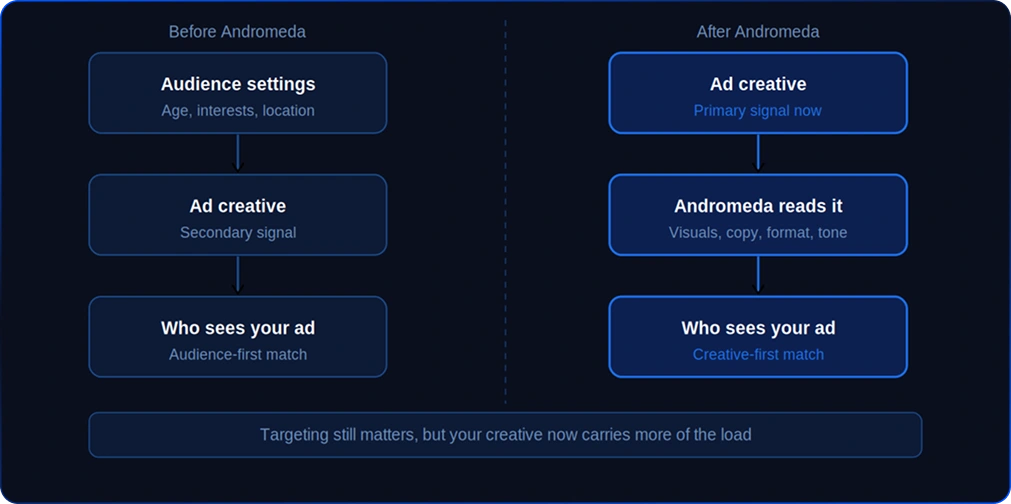
Meta rolled out Andromeda in late 2024, and it was fully operational across the platform by October 2025. It's Meta's new AI-powered ad retrieval engine, and it handles the very first stage of ad delivery: narrowing millions of eligible ads down to a smaller candidate pool before the ranking and auction system takes over.
Here's what makes it different from what came before. Andromeda doesn't start by looking at your audience settings. It starts by looking at your creative. The visuals, the copy, the format, the themes and emotional signals in your ads. It reads all of that and uses it to determine who should see what.
In plain terms: your creative is now doing the job your targeting used to do.
Meta reported an 8% improvement in ad quality on selected segments following Andromeda's deployment. That's not a small number at Meta's scale. It reflects how much more precisely the system can now match ads to users when it's reading the actual content of the ad, rather than relying primarily on demographic and interest settings.
This is a big deal. And it's why the old playbook is quietly breaking down.
Why Creative Diversity Has Become the Biggest Performance Variable
To understand why creative diversity matters so much right now, you need to know about something called the Entity ID system.
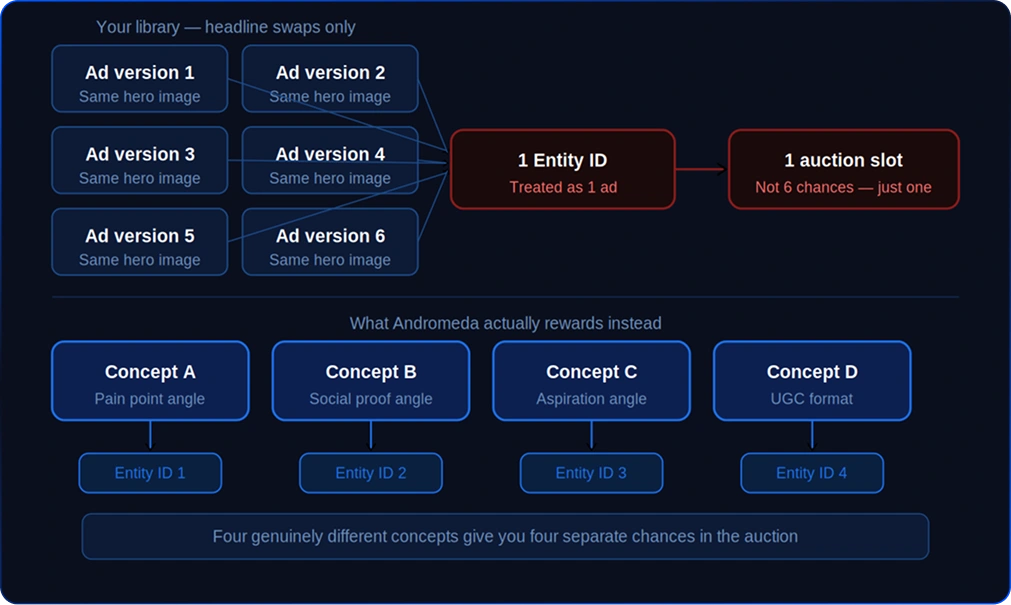
When Andromeda processes your ads, it assigns each one a semantic fingerprint based on visual content, messaging, tone, and format. Ads that look and communicate in roughly the same way get grouped under the same Entity ID. And ads sharing an Entity ID are essentially treated as one ad in the system.
Think about what that means in practice. If you're running 20 ad variations but they all use the same hero image with different headline swaps, Andromeda sees one ad. Not 20. You're getting one shot at the auction, not 20. All that testing, all that volume, and the system has quietly decided you only have one thing to say.
The headline-swap strategy that used to be considered rigorous creative testing is now counterproductive. Andromeda's visual recognition is sophisticated enough to see through cosmetic variations. What it rewards is genuinely different: different angles, different formats, different emotional triggers, different visual stories.
Meta is also rolling out a new metric called Creative Similarity. It flags when your ad library lacks real diversity, and high similarity scores are directly tied to higher CPMs. Sameness is becoming a measurable, billable cost.
The AI Homogenization Problem Nobody Is Talking About Clearly Enough
Here's where it gets interesting, and a little uncomfortable.
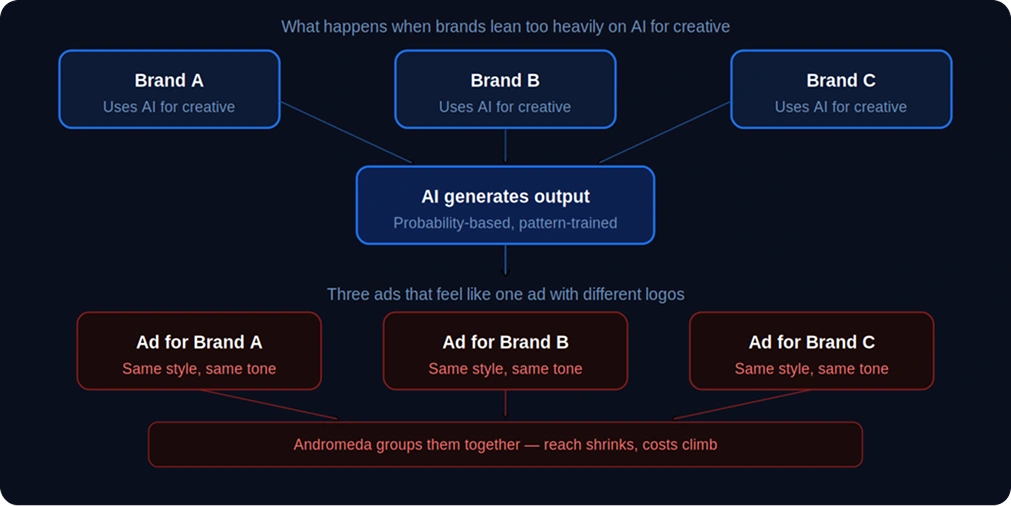
Generative AI tools produce outputs based on probability. They're trained on patterns and they generate what's statistically most likely to be relevant, engaging, or correct. That's genuinely useful for a lot of things. But it also means that when thousands of brands use the same tools with similar prompts, the outputs converge. Everyone ends up producing slight variations of the same creative.
Same visual style. Same copy structures. Same emotional beats. Different logos.
For Andromeda, this is a problem. If your AI-generated ad looks like every other brand's AI-generated ad in your category, the system clusters them together. You're not standing out. You're blending into a pile of content that the algorithm has already seen too much of, and your reach suffers for it.
We want to be direct here, because this point gets misunderstood. This isn't an argument against using AI. We use it ourselves, as a research tool, for drafting, for iteration. It genuinely speeds up production. The issue is using AI as the final creative decision-maker rather than a starting point.
The strategic work, figuring out the distinct angles, the different personas, the emotional hooks that no other brand in your space is using, still requires human thinking. AI can't do that for you because AI, by design, trends toward what already exists. Creative differentiation requires someone who's willing to push in the opposite direction.
What This Actually Means for Your Business and Your Ad Spend
If your ad costs have been climbing and you've been adjusting budgets and tweaking audiences trying to fix it, you've probably been solving the wrong problem.
The businesses seeing real results right now are the ones investing in genuine creative diversity. Not volume for its own sake. Diversity. We're talking 8 to 20 meaningfully different creative concepts running within simplified campaign structures. Different formats: static image, video, UGC, carousel. Different angles: social proof, aspiration, problem-led, humor. Different personas. Different emotional entry points.
$86
$13.87Cost per conversion with 8 diverse creatives
Same offer. Same product. The creative was the variable. Andromeda working the way it was designed to.
That result isn't magic. It's Andromeda working the way it was designed to. The system finally had distinct creative concepts to match to distinct audiences, and it rewarded that with dramatically better distribution.
Practically, here's what this looks like in execution. Stop treating one winning visual as the foundation for all your creative testing. Start thinking about your ad library the way a magazine editor thinks about a publication. Each piece of content needs to speak to a different reader, tell a different story, and earn attention in a different way. And you need to refresh regularly, before fatigue sets in, not after performance has already dropped.
What to Do About It
The first step is to audit your ad library like a strategist, not a production manager. Look at what's live and work through a few honest questions:
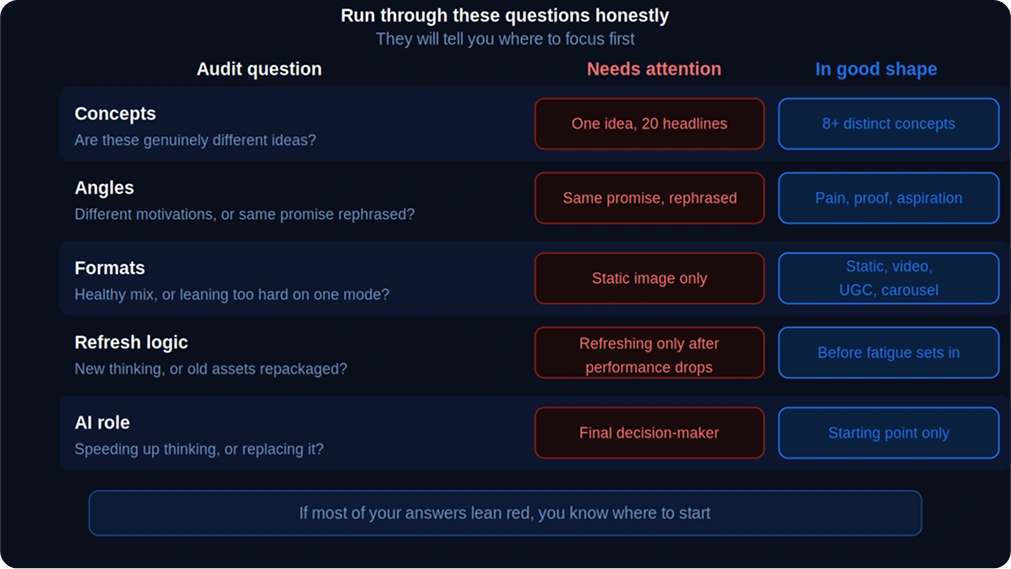
It is also worth asking where AI fits into your process. Is it helping your team think faster, or is it gradually replacing thought with convenience?
That question will become more important as more advertisers flood the platform with increasingly similar creative. The brands that adapt best here are unlikely to be the ones with the most content for content's sake. They will be the ones with the clearest strategic range. The ones willing to let different concepts compete. The ones willing to stop treating creative like decoration and start treating it like distribution strategy.
Because that is what it is now.
The Part We Think About a Lot at Höski
We'll be straight with you. We talk about this stuff internally a lot. And honestly, it's not just a strategic question for us. It's a values one too.
There's a version of this industry where an agency just runs more ads, charges for volume, and lets the client figure out why the results aren't matching the spend. We've seen it. We've seen clients come to us after experiencing exactly that.
That's not what we're here to do.
We've been working with growth-stage and enterprise businesses across North America and beyond since 2017, spanning industries from fine jewelry to med spas to construction to dental practices to automotive. What we've learned across all of that time and all of those categories is that the agencies and clients who get the best long-term results are the ones who understand what the platform actually rewards, and then build creative strategies around that reality.
Andromeda isn't a trick to hack. It's a system that's trying to do something genuinely useful: match the right message to the right person. If you give it genuinely different messages, it can do that job well. If you give it fifty variations of the same thing, it can't. And it'll cost you more for the privilege of that confusion.
So when we talk about creative diversity, we're not just talking about it as a tactical recommendation. We practice it on every account we manage. We audit creative libraries, identify clustering patterns, build distinct concept pools, and measure Entity ID diversity as part of campaign health. We do this because it works, and because we think businesses deserve to know what's actually moving the needle.
You can take a look at our case studies here: Our Work
The Honest Takeaway
Andromeda did not break Meta advertising. But it did make the platform less forgiving. Less forgiving of lazy targeting habits. Less forgiving of recycled ideas. Less forgiving of the assumption that small tweaks count as real testing. The opportunity is still there, but the businesses getting the best out of Meta now are the ones that understand something simple: the algorithm needs meaningful variety.
It needs real diversity. Different angles. Different stories. Different formats. Different reasons to care. That is the work now, and in truth, it has always been the work. Platforms change. Tactics go stale. Best practices age out faster than most people expect. The thing that keeps holding up is thoughtful strategy, clear positioning, and creative that actually feels different because it is different.
So, if your current ad library is heavy on variations of a few core visuals, that's worth looking at seriously. If you've been leaning on AI tools to produce creative at scale without a strategic framework underneath, that's worth revisiting too.
And if any of this sounds like the exact conversation you've been needing to have about your paid ads, that's exactly the kind of work we do at Höski. We help businesses move past surface-level campaign management and build the creative strategy underneath performance.
Start with an honest audit of your ad library. Look for genuine concept diversity. And if that feels like a bigger lift than your current setup can handle, it might be time to bring in a different kind of partner.